
Curious Cases: Mining for gold with Prof Graham Hutchings
SCHEMA Co-Investigator, Graham Hutchings, Regius Professor of Chemistry at Cardiff University, was recently a guest on BBC Radio 4's Curious Cases to discuss gold, and more specifically, its usefulness in science.
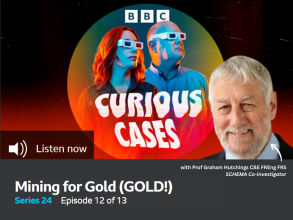
Dara starts off the episode by telling co-host Hanna that he is struggling with what to buy her for Christmas, jokingly explaining that it is because he knows she hates diamonds. "Was that ever on the list?" she asks. Gold, however, could be an option, Hanna reminds him: "Gold, I am in love with gold. It has a special place in my heart." This sentiment is common when considering the popularity of gold and gold jewellery among people all over the world. If Hanna establishes its popularity, Bernie, a caller from Bedford, highlights its multiple uses in everyday life:
"I've read that all the gold that's ever been mined would fit in an Olympic swimming pool. But then I think about the gold in my house and our wedding rings. There's gold in our mobile phones and computers and audio equipment, and sometimes in our teeth. And then I think about the other people in our street and all our ancestors. And I think about the gold in industrial applications all over the world. Isn't the Olympic swimming pool a bit on the small side for all that gold?".
Gold through the ages
Cue the experts: Prof Graham Hutchins and Prof Francis Wall, a professor of applied mineralogy at the Camborne School of Mines, University of Exeter. Prof Hutchings, answers the caller's question by explaining that the World Gold Council indeed keeps a tally, which was 216,265 tons as of the end of 2024. Regarding the history of gold and its different uses, Prof Hutchings says it goes back a long way:
"You can go back to about 40,000 BC, and you will find bits of gold in caves that were known to be inhabited by humans in Spain. Archeologically, it's always been in sort of death masks and jewelry that's associated with royalty and things like this. [But] it's only in the last probably century that we find really different uses for it. In its bulk state-like the wedding ring I'm wearing-it doesn't tarnish. It doesn't react with air. So if your house catches fire, the gold remains; money wouldn't, and silver wouldn't either because it oxidizes. But gold doesn't."
So with all of its different uses throughout history, one would think that more gold should have been extracted by 2024. There is a good reason why not, explains Prof Francis Wall. This is because gold is generally kept in circulation longer than most other metals due to how much it is valued. Gold is passed down through generations, whereas if you look at tin, which has been used since the Bronze Age, often end up discarded.
Gold as a catalyst
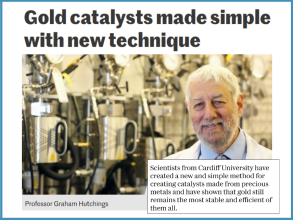
A more recent use of gold is in catalysis, a field in which Prof Hutchings is a leading expert. He recalls being asked to develop a new catalyst for a process that took acetylene and hydrogen chloride and made vinyl chloride, an important monomer for making polyvinyl chloride (PVC). Previously, a mercury catalyst was used, but mercury is a teratogen, and the process ran at 200°C. The mercury would vaporize at about 180°C, releasing around 1,000 tons into the environment annually until very recently. Prof. Hutchings explains:
I was asked to find [a] new catalyst, and it was a scientific paper that gave me the idea. This person had done all the experiments and correlated all these catalytic materials, and came up with a graph that showed no correlation whatsoever. I looked at it and replotted the data in a different way, and I said, if that's right, then gold will be the best catalyst for the reaction. And it is, and it turned out to be a eureka moment.
Gold in space... and beyond
In the final part of the show, the hosts welcome Major Timothy Nigel Peake CMG, a British astronaut, who discusses gold's use in space. He explains how it is used for thermal insulation, radiation shields and mirrors because it is reflective in the visible spectrum and highly reflective in the infrared spectrum, reflecting about 99% of all IR. It is also used on astronauts' helmet visors because it is reflective and malleable, allowing a very thin layer that protects from harmful solar rays while still allowing astronauts to see through it.
Before signing off, the hosts turn to the more frivolous uses of the precious metal, asking the panelists: "Is there any use of gold that you find slightly irritating?" To hear the answers, click the link below.