
Association for the Advancement of Science honours Prof Richard Catlow
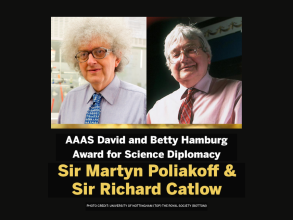
The American Association for the Advancement of Science (AAAS) has announced the 2026 winners of eight awards that recognise scientists, engineers, innovators and public servants for their contributions to science and society. SCHEMA Co-Investigator Sir Richard Catlow, Professor of Catalytic and Computational Chemistry in the School of Chemistry at Cardiff University, was awarded the AAAS David and Betty Hamburg Award for Science Diplomacy along with Sir Martyn Poliakoff, Research Professor of Chemistry at the University of Nottingham.
Winners will be recognised at the 2026 AAAS Annual Meeting, to be held from 12-14 February in Phoenix, where they will be honoured with a tribute video and award ceremony. Recipients of most of the awards receive a prize of $5,000, while the AAAS David and Betty Hamburg Award for Science Diplomacy and Mani L Bhaumik Award for Public Engagement with Science awards receive $10,000. Sudip Parikh, CEO of AAAS and executive publisher of the Science family of journals says: "This year's award winners embody research excellence, service to their communities and leadership for the next generation of scientists. Their stellar example reminds us that we can build a vibrant future for science and technology".
The AAAS David and Betty Hamburg Award for Science Diplomacy recognises an individual or a small group working together in the scientific, engineering or foreign affairs communities making an outstanding contribution to furthering science diplomacy. First established in 1992 as the International Scientific Cooperation Award, AAAS renamed its Award for Science Diplomacy in 2021 for David and Betty Hamburg, who championed science diplomacy throughout their careers in science and medicine as a means of advancing science, human rights, peace and cooperation. The citation for the 2026 award reads as follows:
Poliakoff and Catlow served back-to-back tenures as Royal Society Foreign Secretaries that led to new collaborations between North Korean, British and U.S. scientists on the Mount Paektu project, promoted local and regional research capacity in sub-Saharan Africa and strengthened European science ties in the wake of Brexit. The two chemists have also supported early-career researchers in China, Cuba and Ukraine, among other countries. Catlow has been a strong advocate for the international mobility of scientists, and Poliakoff has engaged global audiences about the benefits of green chemistry through his popular "The Periodic Table of Videos" series.
Prof Catlow spoke to the University College London news team, where he served as Head of Chemistry from 2002 to 2007 and Dean of the Faculty of Mathematical & Physical Sciences from 2007 to 2014. He said:
I am delighted that Martyn and I have been honoured with this award which recognises the importance of international scientific collaboration and of the key role of science as a bridge between nations and communities with different cultures and politics. I have engaged with the scientific community in the global north and global south throughout my career and it has been an enriching experience. I am also pleased that the award recognises the roles that Martyn and I played as Royal Society Foreign Secretary, as the society has since its foundation over 360 years ago promoted science as an international endeavour.
The other 2026 award recipients are:
- AAAS Philip Hauge Abelson Prize: Gilbert S Omenn
- AAAS Mani L Bhaumik Award for Public Engagement with Science: Lesley-Ann L Dupigny-Giroux
- AAAS Early Career Award for Public Engagement with Science: Linda Lara-Jacobo
- AAAS Award for Scientific Freedom and Responsibility: Morteza Mahmoudi
- AAAS Lifetime Mentor Award: Mary Jo Ondrechen
- AAAS Mentor Award: Elham "Ellie" Fini
- AAAS Newcomb Cleveland Prize: "Durably reducing conspiracy beliefs through dialogues with AI" published in Science
Links:
Learn more about the awards' history, criteria and selection processes.
Read the UCL article