
Renewable Polyesters for Recyclable and Repairable Composite Resins
The global epoxy resin market was valued at USD 11 billion in 2023 (UK: USD 264 million in 2022), while the composites market reached USD 94 billion globally in 2022 (Europe: USD 19 billion). These materials are critical for applications such as wind turbine blades, but conventional thermoset epoxy resins pose significant challenges over their life-cycle: they are difficult to repair, remanufacture, and recycle, and the recovery of valuable reinforcing fibres like carbon fibre remains problematic.
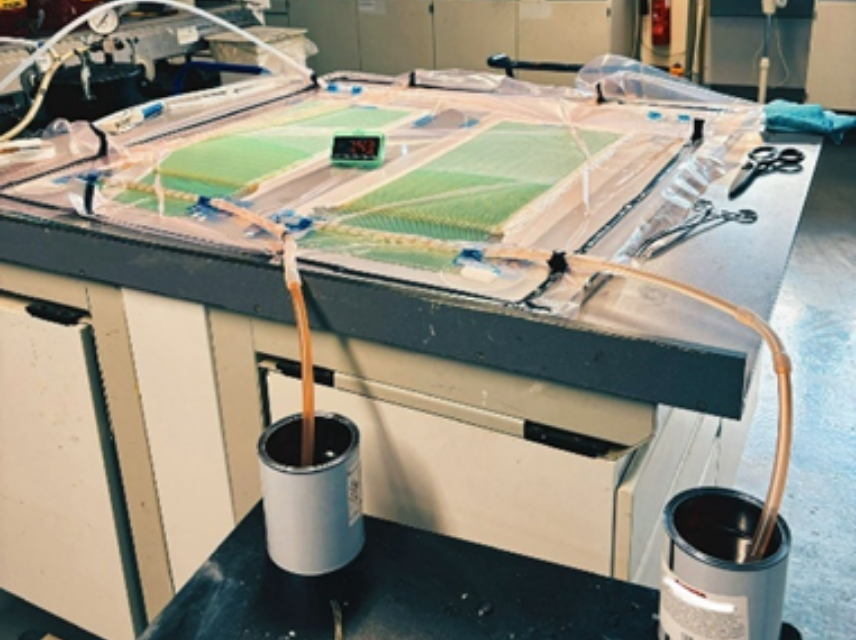

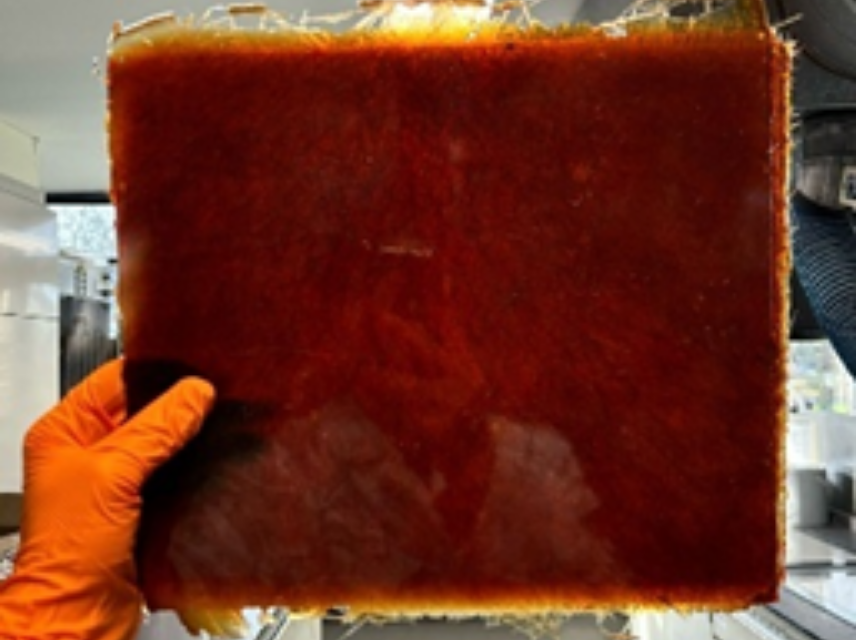
Future energy generation depends on composite materials that are both high-performance, sustainable, and recyclable. The project aimed to overcome limitations of conventional epoxies by developing renewable polyesters that enable recyclability, repairability, and remanufacturing, while being compatible with existing manufacturing processes.
This project was delivered through a close collaboration between Dr Mati Concilio (University of Oxford) and Dr Stefan Lawrenson and Dr Steven Brown from Scott Bader, a leading composite materials manufacturer. From the outset, Scott Bader provided critical input on process safety and feedstock selection (e.g. starting material toxicity and compatibility) as well as manufacturing requirements (e.g. viscosity parameters), allowing for careful design of polyester resin materials.
Aims of the project:
- The design and synthesis of polyester resin matrices from commercially available, renewable feedstocks with no purification required.
- Compatibility with current resin manufacturing processes and equipment.
- Development of high-performance resins suitable for composite applications.
Utilisation of polyester chemistry to facilitate dynamic exchange reactions and enable easier, low-energy recyclability and repair.
Outputs and impact from the project:
- A series of renewable polyesters with viscosities suitable for current resin processing methods - demonstrating potential for scaling up through Scott Bader's industrial facilities.
- Developed resin formulations with competitive mechanical performance and low-energy recycling pathways - evaluated the chemistry and conditions needed for repair and reprocessing of the resins and determined their energy requirements.
- The project featured a researcher secondment to Scott Bader's Wollaston site for technology transfer, material exchange, and industrially-relevant testing of promising resins.
- Senior R&D engagement, including Dr Stefan Lawrenson contributing to SCHEMA Hub conferences and providing insight into sustainable material design and manufacture.
- Instrumental in securing additional support through an EPSRC Impact Acceleration Account for follow-on research to widen applications and assess manufacturing feasibility.
This project highlights the value of academia-industry partnerships in addressing global sustainability challenges. The combination of academic innovation in polymer chemistry and Scott Bader's industrial expertise and infrastructure facilitated the development of renewable resins that balance performance, sustainability, and manufacturability.