

New predictive method for manufacturing low-pressure CO₂-based polymers
One promising route to more sustainable plastic production is the ring-opening copolymerisation (ROCOP) of carbon dioxide with epoxides to produce polycarbonates. This method transforms CO2 – an abundant, low-cost C1 feedstock – into value-added polymers and materials. Current catalysts for this method, however, often require high CO2 pressures, which increases cost, energy use, and safety risks. Developing catalysts and processes that operate effectively at lower pressures is therefore a key challenge.
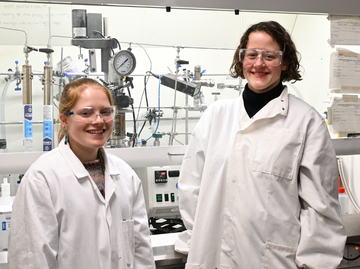
Co-authors Rosie Thorogood and Katharina Eisenhardt
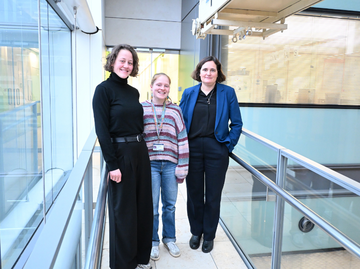
The researchers with Prof Charlotte Williams
In an article published today in Nature Chemistry, researchers from Oxford Chemistry introduce a new predictive method to assess epoxide/CO2 ROCOP catalyst performance under low carbon dioxide pressures. Their methods apply generally to many of the best catalysts already published in the field.
Using detailed kinetic analysis, the team discovered that many catalysts undergo carbon dioxide insertion reactions which are chemical equilibria. The team worked out a series of generally applicable relationships that enable determination of the equilibrium constants for carbon dioxide insertion, and their correlation with polymerisation rates. This allowed them to predict the minimum carbon dioxide pressure required for each catalyst to reach optimal performance, providing a quantitative metric with industrial relevance.
This is the first reported method to predict low-pressure performance for these scalable carbon dioxide utilisations, offering a rapid tool for scientists to design both better catalysts and more sustainable polymerisation processes. The team’s findings highlight how fundamental kinetic and mechanistic understanding can directly inform practical solutions for advanced manufacturing.
PhD student Rosie Thorogood said:
This project really showed me the wider implications of our day-to-day research, and how we can begin to translate our science to sustainable and industrially relevant technologies. It is incredibly exciting to think that the work you do on a lab scale could be used to advance sustainability targets, and it’s something I’m really passionate about.
Postdoctoral researcher Katharina Eisenhardt added:
“I think one of the most exciting things about this research is that it really demonstrates that detailed mechanistic studies are not some niche academic interest, but can actually have very important implications in process design.”

