

SCHEMA researchers showcase work in Bordeaux
Bonny Gao (Affiliate PhD researcher)
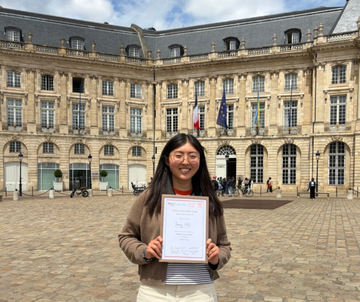
Bonny with the Elsevier Poster Prize

Place de la Bourse, Bordeaux
Poster title: Recyclable CO2-Derived Plastics and Elastomers Toughened by Strain-Induced Crystallization [Elsevier Poster Prize winner]
About the poster: In this work I improve the thermal and mechanical properties of block copolymers based on CO2-derived polycarbonates and polyesters so that they match the existing fossil-based commercial polymers. The best-performing plastics and elastomers show tensile mechanical properties comparable to conventional styrene-based polymers. The new materials can also be chemically recycled in a closed-loop process.
Dr James Runge (Postdoctoral Research Associate)
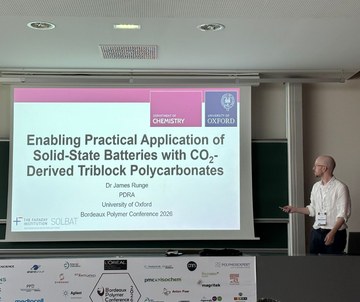
James introduces his talk at BPC2026
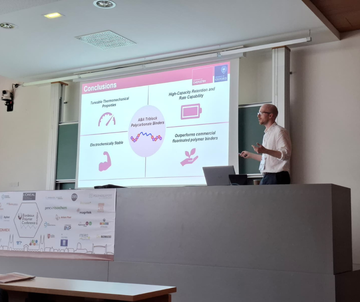
James completed his PhD in 2024
Talk title: Enabling Practical Application of Solid-State Batteries with CO2-Derived Triblock Polycarbonates
About the talk: It was based on work from my previous postdoc position with Prof Charlotte Williams on the Faraday Institution SOLBAT project where we have used CO2-derived ABA-type triblock polycarbonates as binders for solid-state composite cathodes. The polymers could be easily synthesised in one-pot and show tuneable thermomechanical properties by varying the content of “hard-block” in the final polymer structures. The binders synthesised in this work allow for the practical operation of solid-state cells at low stack pressures and ambient temperatures (<5MPa, 30 °C) and outperform commercial and fluorinated binders typically used in battery applications.
James says of the BCP 2026: "The conference was fantastic; it was great to see a diverse range of work and meet many researchers from the polymer community."
Balázs Striker (Affiliate PhD researcher)
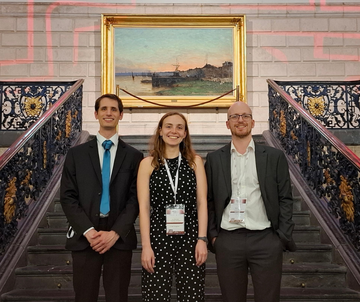
Balázs with colleagues
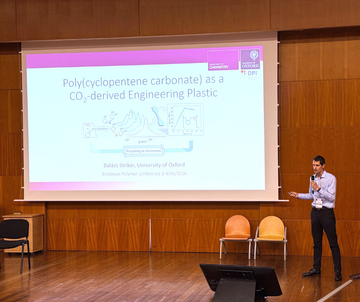
Balázs delivers his talk
Talk title: Poly(cyclopentene carbonate) as a CO2-derived Engineering Plastic
About the talk: I presented on renewable-based poly(cyclopentene carbonate) as a potential engineering thermoplastic and presented an investigation on how various molecular weight distributions, typical in the CO2-based polymer field, affect thermal-mechanical performance and recycling properties. It was a fantastic experience to present to the leading experts of polymer chemistry, as well as learn about the science and prospects of sustainable polymers, additive manufacturing, mechanochemistry and precision synthesis to name a few. It was great to engage in discussions ranging from healthcare applications to environmental decontamination.
Dr Hyun Suk Wang (Postdoctoral Research Associate)
Talk title: Depolymerization of commercial polymethacrylates via light-triggered backbone-initiation
About the talk: It was based on work from my previous position in the Anastasaki Group at ETH Zurich. Polymers containing all-carbon backbones are challenging to chemically recycle, requiring pyrolysis at temperatures typically exceeding 400 °C. This work depolymerizes quantitatively commercial polymethacrylates (i.e., Plexiglas/acrylic glass) at 150 °C through a novel backbone-initiated route triggered by visible light.
Hyun says of the conference: "Amazing atmosphere that was a combination of great science, people, and, most importantly, food."

